Table of contents
Open Table of contents
Introduction
So I’ve finally gotten around to writing a post how to do the Muster Parade. But first, what is the Muster Parade? Well, it is a way for the unit/contingents/squads to report their strength (i.e. attendance) to the commanding officer, which could be a TO, HO, CLT or AFI.
Layout
The layout is as follows:
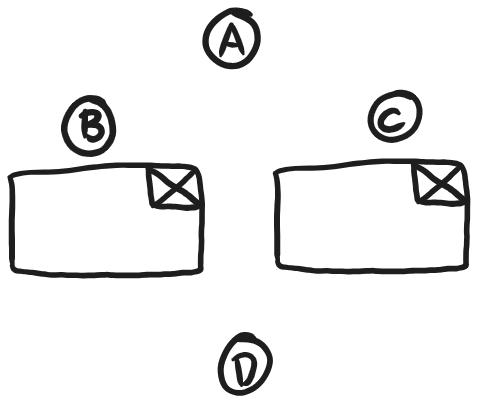
People involved
- Boxes with X: the 2 Rotas (there can be more than 2), and the right-marker (X).
- (A): Overall IC/CSM/USM
- (B), (C): Rota ICs
- [OPTIONAL] (D): Deputy Overall IC
People (B), (C) and (D) all face front, with (A) facing them.
Order of commands
- OIC: BARIS, SEDIA
- OIC: BARIS, KE KANAN LURUS
- OIC: PANDANG KE HADAPAN, PANDANG
- OIC: BARIS, SENANG DIRI
- OIC: ICs, PANGGIL NAMA
The timing for PANGGIL NAMA is 1-2-check-turn-check-one, where 1-2 is SEDIA, and turn-check-one is a KE BELAKANG PUSING to face the Rota.
⚠️ IMPORTANT: After the OIC gives the command PANGGIL NAMA, Rota ICs are to call out the names of cadets in their Rota. When called, cadets should SEDIA themselves, then shout ‘HADIR’ (meaning ‘present’). Only when the next cadet is called can the previous cadet SENANG DIRI themself. When the Rota IC calls out the last cadet, they are to instead say ‘Last man
’ (e.g. ‘Last man Sergeant John Tan’) instead of just ’ ’ (e.g. ‘Sergeant John Tan’).
- Rota ICs: Squad, SEDIA
- Rota ICs: Squad, DIAM
Now, the Rota IC should KE BELAKANG PUSING to face the front, before marching to the OIC to report strength.
How to report strength
- Upon reaching the OIC, the Rota IC is to BERHENTI themselves
- If required, the Rota IC will salute
- Wait until the OIC puts down their hand, before putting down your hand
- Greet the OIC
- Ask permission to report strength: “Permission to report strength for Rota
, ” - If granted, list the following:
- Total strength: how many cadets there are in the Rota/attendance sheet
- Current Strength: how many cadets are present today
- Active strength: how many can participate in activities (not sick/injured)
- Salute again
- March back to Rota
⚠️ IMPORTANT: When about to march back to the Rota, turn to the right and march off and not behind. As a sign of respect, don’t show your back to the OIC.
- Rota ICs: Squad, at ease
- Rota ICs: Squad, SENANG DIRI
After this, the Rota IC is to KE BELAKANG PUSING to face the front, before doing SENANG DIRI.
- OIC: BARIS, SEDIA
- OIC: BARIS, DIAM
Now, the OIC will report total strength of both Rotas to the TO/HO/CLT/AFI. The procedure is mostly the same as above.
- OIC: BARIS, at ease
- OIC: BARIS, KELUAR BARIS
End-of-day Muster Parade
The steps are the same until step 5, where after the PANGGIL NAMA command is given, the Rota ICs do not call out all the names of the cadets, instead after issuing the SEDIA command to the Rota, giving the command DARI KANAN, BILANG. Sounds familar? Yep, this is part of the 2nd sizing command. Here, the cadets in the front row number off: satu, dua, tiga, empat, lima, enam, tujuh, etc. After the last cadet says their number, they are to also say how many blank files, as indicated below:
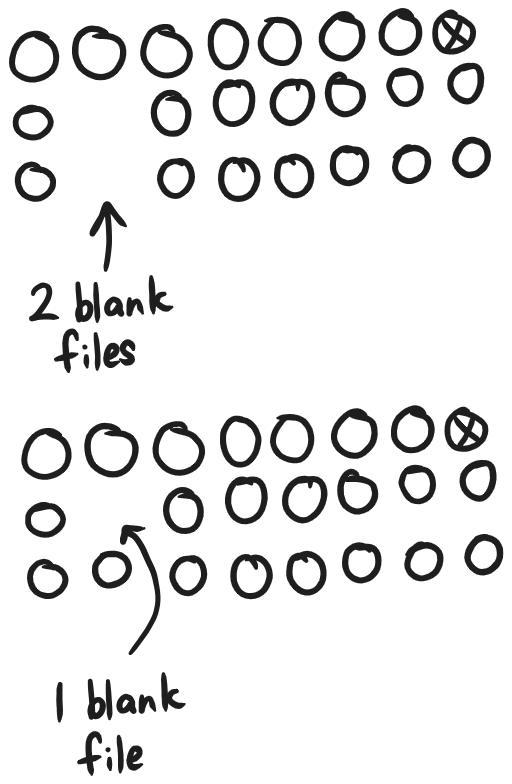
This way, the Rota IC can quickly calculate how many people there are now. If the last cadet calls out ‘lapan’, which is 8, and there are 3 rows, so 8x3=24, and if there are 2 blank files, then 24-2=22. So the Rota IC just needs to check if there were 22 cadets at the start of the day, instead of calling out everyone’s names.
Then, Rota ICs continue from step 7 onwards as usual.
Conclusion
So there - that is the Muster Parade, where you take and report strength. You’ll encounter this in your Specialisation Course, the UDI course, etc, so be prepared! Note how the Rota ICs perform, becuase one day, you might be in that place. Good luck!